完全長マウスゲノムの完成
将来の展望
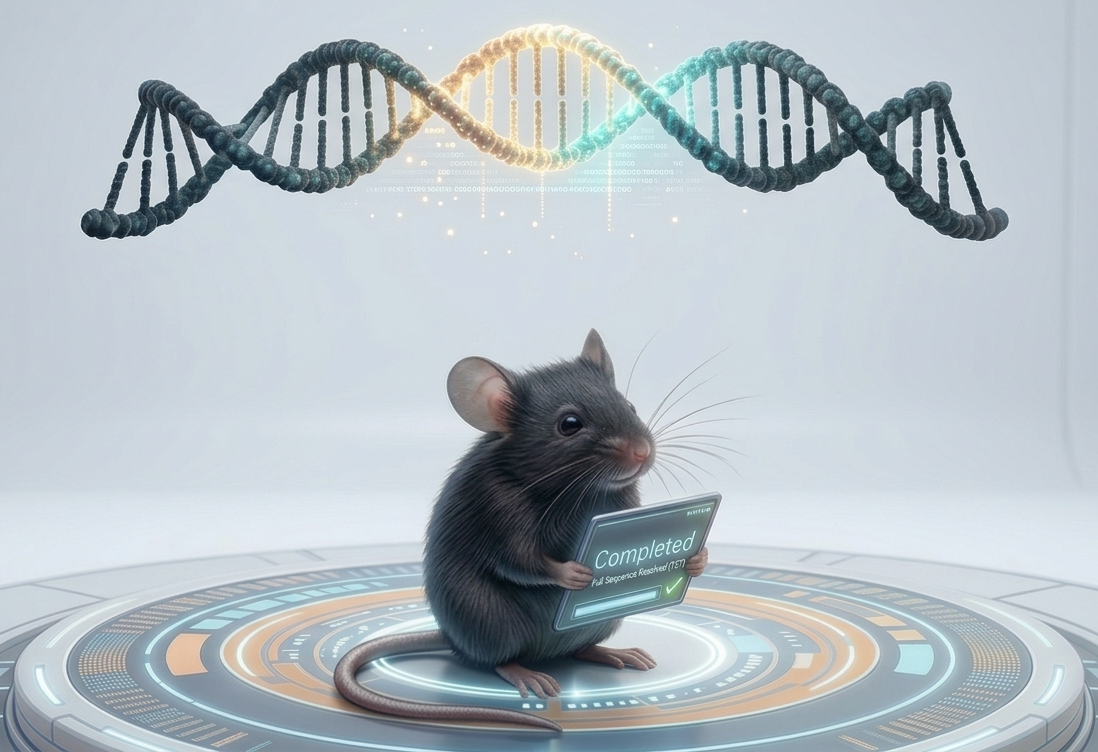
C57BL/6系統、C57BL/6J系統、CAST/EiJ系統の完全長ゲノムからは、それぞれ140種類、225種類、355種類の新しいタンパク質コード遺伝子が見つかりました。そのため、一方では、これまで塩基配列を解読できていなかったテロメア領域やセントロメア領域と合わせて、これから機能解析が盛んにおこなわれると期待されます。他方では、血球細胞における体細胞変異の加齢性蓄積16のようにマウスのさまざまな組織・細胞種にある体細胞変異を検索して、機能的に解釈する研究が加速すると予期できます。
また、ヒトゲノムにおいて塩基配列の人種間の違いがHuman Pangenome Reference Consortium(HPRC)17によって詳しく調べられ始めているように、マウスゲノムの系統間の違いも詳しく調べられ始めています。2023年5月には、20種類(BALB/cByJ、BALB/cJ、C3H/HeJ、C3H/HeOuJ、C57BL/6NJ、DBA/2J、PWD/PhJ、129S1/SvImJ、A/J、CAST/EiJ、NOD/ShiLtJ、NZO/HILtJ、PWK/PhJ、WSB/EiJなど)のマウス系統のゲノムの塩基配列について、長鎖型シークエンサーを使って比較解析した結果が報告されました18(Jackson Laboratoryによる解説)。かつてヒトゲノムの解読が、米・英・仏・独・中・日をまたぐ20の研究機関による国際的な研究計画(ヒトゲノム計画)と米国の民間企業(セレラ・ジェノミクス社)の競争によって強く推進されたように、これからも国際的な協働と競争がマウスのゲノム科学を推進していくと期待されます。今後さらにさまざまな系統の完全長ゲノムが整備されれば、実験に最適な系統をゲノムの観点から選別できるようになるかもしれません。
引用文献
1. Lander, E. S. et al. Initial sequencing and analysis of the human genome. Nature 409, 860–921 (2001).
2. Craig Venter, J. et al. The sequence of the human genome. Science (80-. ). 291, 1304–1351 (2001).
3. Hattori, M. Finishing the euchromatic sequence of the human genome. Nature 431, 931–945 (2004).
4. Nurk, S. et al. The complete sequence of a human genome. Science (80-. ). 376, 44–53 (2022).
5. Rhie, A. et al. The complete sequence of a human Y chromosome. Nature 621, 344–354 (2023).
6. Mouse Genome Sequencing Consortium. Initial sequencing and comparative analysis of the mouse genome. Nature 420, 520–562 (2002).
7. Liu, J. et al. The complete telomere-to-telomere sequence of a mouse genome. Science (80-. ). 386, 1141–1146 (2024).
8. Francis, B. A. et al. Complete genome assemblies of two mouse subspecies reveal structural diversity of telomeres and centromeres. Nat. Genet. 57, 2852-2862 (2025).
9. Li, H. & Durbin, R. Genome assembly in the telomere-to-telomere era. Nat. Rev. Genet. 25, 658–670 (2024).
10. Jain, M. et al. Nanopore sequencing and assembly of a human genome with ultra-long reads. Nat. Biotechnol. 36, 338–345 (2018).
11. Wenger, A. M. et al. Accurate circular consensus long-read sequencing improves variant detection and assembly of a human genome. Nat. Biotechnol. 37, 1155–1162 (2019).
12. Lieberman-Aiden, E. et al. Comprehensive Mapping of Long-Range Interactions Reveals Folding Principles of the Human Genome. Science (80-. ). 326, 289–293 (2009).
13. Selvaraj, S., Dixon, J. R., Bansal, V. & Ren, B. Whole-genome haplotype reconstruction using proximity-ligation and shotgun sequencing. Nat. Biotechnol. 31, 1111–1118 (2013).
14. Burton, J. N. et al. Chromosome-scale scaffolding of de novo genome assemblies based on chromatin interactions. Nat. Biotechnol. 31, 1119–1125 (2013).
15. Kaplan, N. & Dekker, J. High-throughput genome scaffolding from in vivo DNA interaction frequency. Nat. Biotechnol. 31, 1143–1147 (2013).
16. Kapadia, C. D. et al. Clonal dynamics and somatic evolution of haematopoiesis in mouse. Nature 641, 681-689 (2025).
17. Wang, T. et al. The Human Pangenome Project: a global resource to map genomic diversity. Nature 604, 437–446 (2022).
18. Ferraj, A. et al. Resolution of structural variation in diverse mouse genomes reveals chromatin remodeling due to transposable elements. Cell Genomics 3, 100291 (2023).
 大阪大学大学院医学系研究科 廣瀬直毅
  シェア
シェア シェア
シェア